Friday, June 29, 2018

Thursday, June 28, 2018
Wesch and Turkle
I believe that both Wesch and Turkle bring powerful statements to the table, much of what connects to what we have been discussing in class this week. Technology is going to be around forever, but how we use it needs to be reevaluated. I believe that in a way, Wesch uses Turkles "argument" to help his.

Wesch starts off the article Anti-Teaching: Confronting The Crisis of Significance by stating "students- our most important critics- are struggling to find meaning and significance in their education". For me, this was extremely powerful to read and connects back to this week. Students, just like educators, need to find their WHY. Why are they in school? Why is there such a need for them to be critical thinkers? Why do they need to learn?...but then Wesch continues to state "The only answer to the best question is another good question". Students need to be pushed to ask questions that are going to lead them to more questions and further their thinking. It is going to be this that produces learning. I agreed with Wesch when he discussed that learning school has become a "meaningless game of grades rather than an important and meaningful exploration of the world in which we live and co-create". This made me think of my own education and how at some points, I was more worried about the grade rather than the learning that was produced. It made me think about how different that experience could have been for me if I was pushed to ask questions and dig deep into the learning. Overall, I believe that Wesch's argument was for students to become "active lifelong learners" who have these skills that will carry them anywhere they want as long as they have an environment that helps.


"My job becomes less about teaching, and more about encouraging students to join me on the quest" - Michael Wesch
"Meaning and significance are assured only when our learning fits in with a grand narrative that motivates and guides us" -Michael Wesch
On the other hand, Turkles argument is explicitly about technology and how it has gotten in the way of being able to have conversations. The Goldilocks effect that Turkle discusses is something that really stuck with me. She states it as "We can't get enough of one another if we use technology to keep one another at distances we can control: not too close, not too far, just right". I believe her main argument is that we need to be able to find the balance to disconnect from technology in order to keep those face-to-face connections alive. She talks about having digital free rooms, which I love the idea of. I grew up not being able to have a cell phone at the dinner table. To this day, it is still something that I believe strongly in. I find it so sad that when I go out to eat, a family will all be on their phones rather than engaging in personal conversation and interacting with each other. She sums up her article by stating "But in our rush to connect, we flee from solitude, our ability to be separate and gather ourselves".
"Our colleagues want to go to that board meeting but pay attention only to what interests them" -Sherry Turkle
While I don't think that Wesch and Turkle are necessarily allies, I don't think that they are in opposition either. Wesch doesn't bring up technology in his argument. But I think they agree on the idea that something needs to change. One connection that I did find between Turkle and Wesch was about the question people are asking. Wesch discussed the basic questions that students are asking in regards to what they need to know for a test, or how much of a grade it will be, etc whereas Turkle discusses how people want faster answers now and to do that we "ask one another simpler questions; we dumb down our communications, even on the most important matters".
I was extremely moved by both of these articles in different ways. Turkle moved me in a personal way. To make sure that I am engaging in connections with people rather than being on my phone in some instances. This is something that I feel like I am decent at, but definitely, have room for improvement. Turkle gave me a push I need to try and work on it. Wesch moved me in an educational sense. To make sure that my students find their why and that I take a step back from the teaching and ask my students to join me through the learning.
Let's Make Stuff
Shena, Mary Sue, & Jackie





Our people represent that no matter how different we are, we can come together to change the world!

This hero shows us that we can be reserved and be able to show off our superpowers, just not in a way that "people" would expect.

This person represents the non-conventional female role, wearing a purple tutu while wearing her sports team and holding a baseball glove.

This person represents someone who is gender neutral and sometimes people make assumptions because of what they see on the outside.
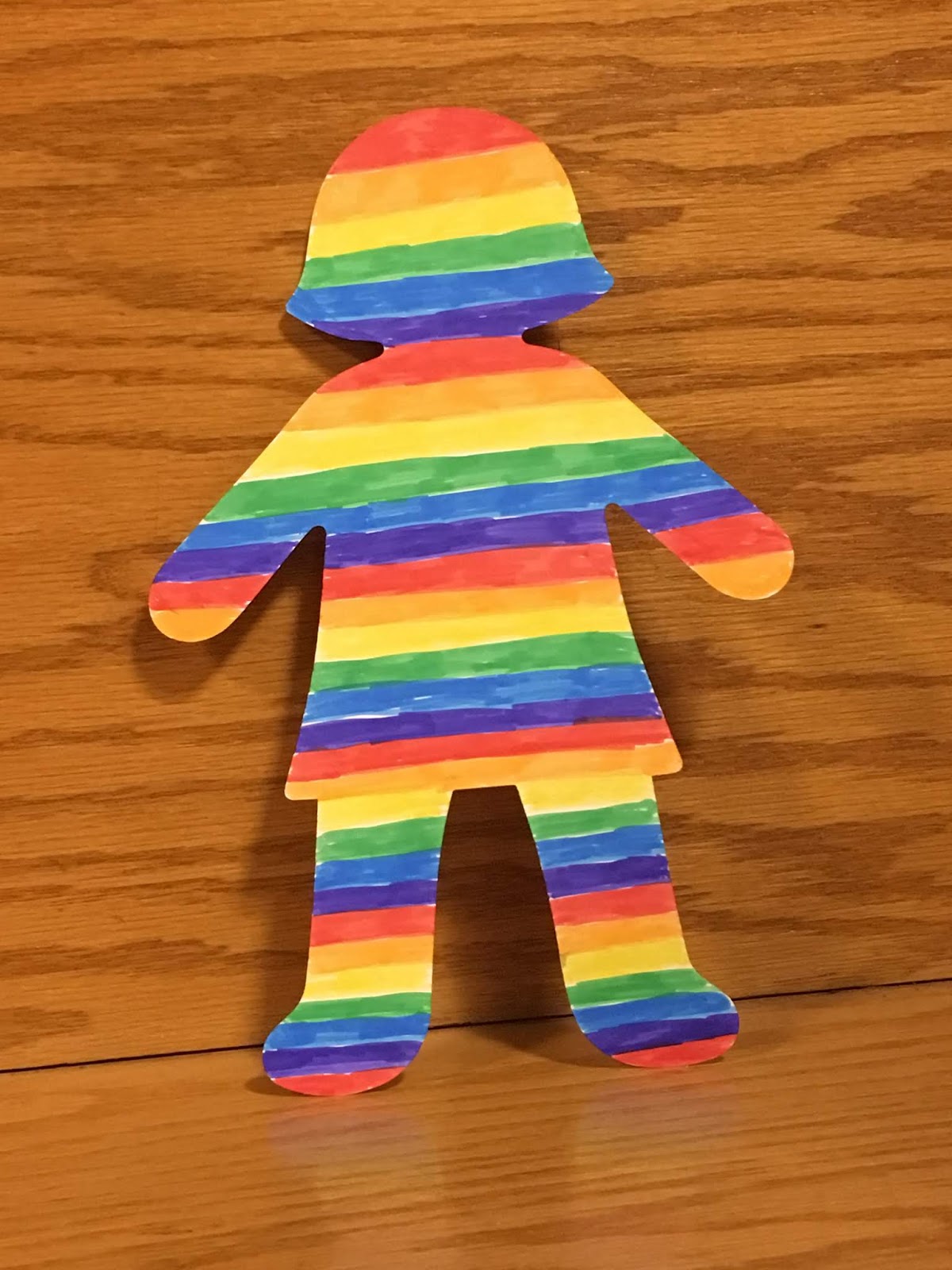
This person represents everyone in the LGBTQ community and that they are an important piece of our larger society.

This person represents those who are different and defy definition in our socially constructed world.
Together, these people can work towards a community of one!


Wednesday, June 27, 2018
EdPuzzle
EdPuzzle is a FREE online tool that allows your students to learn through video.

The magic with EdPuzzle is that you can make your own video and upload it for students or you can use one of the many videos that are provided in a library. Another great feature of EdPuzzle is that you can assign students a video to watch and see who has actually watched it. Taking that piece a little bit further, EdPuzzle allows you to pick a spot for the video to stop so that you can insert a question to determine if students are actually watching the video or not. If there is just a piece of a video that you want to use for students, there is a crop video feature.
From experience, my students enjoy using EdPuzzle. I've used it during independent time and during blended learning. I have found that it has helped some of my struggling students grasp ideas that I just wasn't able to connect with them on. Many of my students who are visual learn would ask for me to put a video on EdPuzzle in regards to the content that we were learning. As a teacher, I liked that my students were engaged in the material and that I was able to see if they were understanding through the questions I put into the videos. EdPuzzle gives a report on each video so that teachers have data to look back on. Another great thing is that it connects directly to Google Classroom, so students only have to log into that account.
I have never uploaded a video and have only used what is in the resource library. I have to say, while there are some great videos for certain content, some content was extremely difficult to find a video. Sometimes I would spend so much time looking for a video that was at the level of my students and still engaging, but I knew the outcome would be worth it.
Signing up is really easy, and did I mention FREE!
Below, I have provided step by step on how to get started and some of the features.


Once you get signed up, you create classes. I have shown the classes I have in my account.

To begin to find content to add; you can go to either of these places:


Once you find a video that you are interested in using, as stated before, there are features that you can use in the video.

The red scissors allow you to "cut" pieces of the video out and change the timing.

The microphone above the video allows you to insert an audio track.

The question mark on top of the video is where you want to go if you are interested in adding questions into the video or creating a quiz piece. There are options for short answer questions, multiple choice questions, and an essay.

Below is what the data piece looks like from the teacher's dashboard:


Here is an example video that could be used with questions included in it!
Looking for the Girls
"Historically, African Americans have stressed the importance of moving the entire community forward. Yet, these videos promote the progress of the individual by any means necessary" (pg. 189)
Reading Andrea Brown-Thirston's Looking for the Girls was eye-opening into the media that African Americans are exposed to. Andrea Brown-Thirston is an African American woman who took a day to watch R&B and hip-hop music videos. In addition, Brown-Thirston is the chief academic officer at the Chicago International Charter School. Her goal by watching these videos was to "get an idea of the images and messages that a child could potentially see" (pg. 187)
Some of the songs that she watched and discussed in this essay were "What You Want" by rapper DMX and "How Many Licks" by rapper Lil' Kim. These two videos touch upon social class and gender role issues. "Sisqo sits on the roof of a car that few men, let alone teenage boys, could afford" (pg. 188) which touches upon the social class issue. The video shows that fancy cars are an important part of life and that having that car will get you all of the girls. In the same video, it had a girl "lying across the car, with her legs spread apart and her head thrown back" (pg. 189). This is not an image that young women should see themselves portrayed as.
Some of the songs that she watched and discussed in this essay were "What You Want" by rapper DMX and "How Many Licks" by rapper Lil' Kim. These two videos touch upon social class and gender role issues. "Sisqo sits on the roof of a car that few men, let alone teenage boys, could afford" (pg. 188) which touches upon the social class issue. The video shows that fancy cars are an important part of life and that having that car will get you all of the girls. In the same video, it had a girl "lying across the car, with her legs spread apart and her head thrown back" (pg. 189). This is not an image that young women should see themselves portrayed as.
“The women in the videos become the standard by which beauty and desirability are measured. Black girls may internalize these images and begin to accept the role of sex object” (pg 189)
Brown-Thirston goes on to discuss the effects that R&B and hip-hop music videos have on youth. She describes the music videos that she watched as "dangerous because they expose young Black men and women to a range of negative images" (pg. 188). These images include showing women as objects rather than the individuals that they are. The videos also do not depict relationships with an equal representation, something that we should be promoting everywhere. As far as messages for men, especially African-American, it shows that money can buy you everything. And by everything, she means women who are "beautiful, sexy, and seductive" (pg. 189).

Toward the end of the essay, the author asks some really great questions and tried to provide answers. These questions include, "What are the priorities we should be promoting? What are the alternatives to what the mainstream media feed our children?" (pg. 190). These questions are great guiding questions that I'm not sure anyone has specific answers to yet. If we did, I'm not sure that we would still need to be critically analyzing media as much as we are.

While reading, I was able to make connections to Boyd and Christensen. Brown-Thirston state that she believes "we should encourage children to start being critical rather than passive consumers of the media" (pg. 190). Christensen also believes that youth need to be able to see things critically. This can be done by developing a critical consciousness in youth. We, as educators and adults in children's lives, need to develop this critical consciousness so that we can then continue to encourage children to analyze the media that they are consuming. In connection with Boyd, this only can be done by experience. Brown-Thirston states "In other words, adults need to give children opportunities to openly and honestly discuss the images in music videos and media in general" (pg. 190). Boyd believes that youth need time and opportunities to explore.
This essay really allowed me to see the connections in what we have been studying this week and the importance of students being able to critically analyze the media around them. I found this article that explains the effects from a different perspective.
Tuesday, June 26, 2018
Frozen in Disney
I have to admit, I love Disney movies and pretty much everything with Disney. I grew up watching Disney movies with my family. I went to Disney World every few years as a child. For me, Disney World and Disney movies were magical and somewhere would I could escape too. Although I had this love for Disney movies, especially the princess, I do remember at a young age feeling like I was not one of them. Christesen stated it perfectly by saying "My waist didn't dip into an hourglass; in fact, according to the novels I read, my thick ankles doomed me to be cast as the peasant woman reaping hay while the heroine swept by with her handsome man in hot pursuit" (pg. 175). Of course, I never would have thought about it that deep when I was younger, but the idea still stays the same. With all that in mind though, even as an adult, I still love watching Disney movies and get excited when a new one comes out. I do have a feeling after this class I will have a harder time sitting back to enjoy them without critically analyzing each new one.


"And often that world depicts the dominations of one sex, one race, one class, or one country over a weaker counterpart" (pg. 175)
This quote from Christensen really stood out to me because I do feel that looking back, a lot of these movies and films are always putting one of something, whether it be sex, race, class, country, etc, over others. It is unfortunate that this is how children have to grow up seeing this as an example. While reading, Unlearning the Myths that Bind Us, I kept thinking about my students and how I could connect this with them. I teach in a lower-income community, so I think it would be really interesting to do something with my students to see what there take is. As stated in the text, "I want my students to question this accepted knowledge and the secret education delivered by cartoons as well as by the canon" (pg. 176). I am really thinking about taking some students in the fall and completing a project/unit like this. I would also like to get other staff members involved because just as "many students don't want to believe that they have been manipulated by children's media or advertising" (pg. 177) adults do not want to believe it either.
"Both of these tales leave young women with two myths: happiness means getting a man, and transformation from wretched conditions can be achieved through consumption" (pg. 182)
On the other hand, Frozen (2013) is a story where two female leads are strong. For me, this is a huge turning point in the "Princess" world. Ana and Elsa seem to prove over and over again throughout the movie that they do not need a man to save them, although there are instances where Hans and Christof do save them in the moment. The story is focused around the two women and ultimately they save each other. Personally, I love that in Frozen, their happiness had nothing to do with getting a man. The reward, in the end, was that the gates stayed opened and everyone was happy all together.
To be completely honest, although I am beginning to be able to critically examine media, I do fear that my love for Disney and this movie might have gotten in the way at some points of seeing past things and looking for the deeper meaning. I look forward to our discussion in class tomorrow to determine what I might have "overlooked" or what I might not have seen through the same lens as classmates.
***After posting originally, I went online and searched a little bit more. I came across this article. Little bit of a long one, but brought up some interesting points that I definetly did not think of while I was watching the movie or while I was writing my post.
Subscribe to:
Comments (Atom)